8171 Registration Update 2026: Complete Guide for New and Existing Beneficiaries in Pakistan

8171 Registration Update
The 8171 Registration Update 2026 marks a major step forward in Pakistan’s social welfare system. Designed to improve transparency, speed, and fairness, the updated process helps ensure that financial assistance reaches families who truly need support. With stricter verification and better data coordination, the system now minimizes errors that previously caused delays or disqualifications.
You Can Also Read: Smart Meter Installation Pakistan 2026: How Real-Time Meters Could Save Consumers ₨25 Billion Annually

For both first-time applicants and existing beneficiaries, understanding the updated registration and verification flow is essential. Many households lose benefits not because they are ineligible, but because they fail to follow the latest procedures correctly. The 2026 update focuses on accuracy, regular data validation, and improved access for people living in underserved regions.
Purpose of the 8171 Registration System in 2026
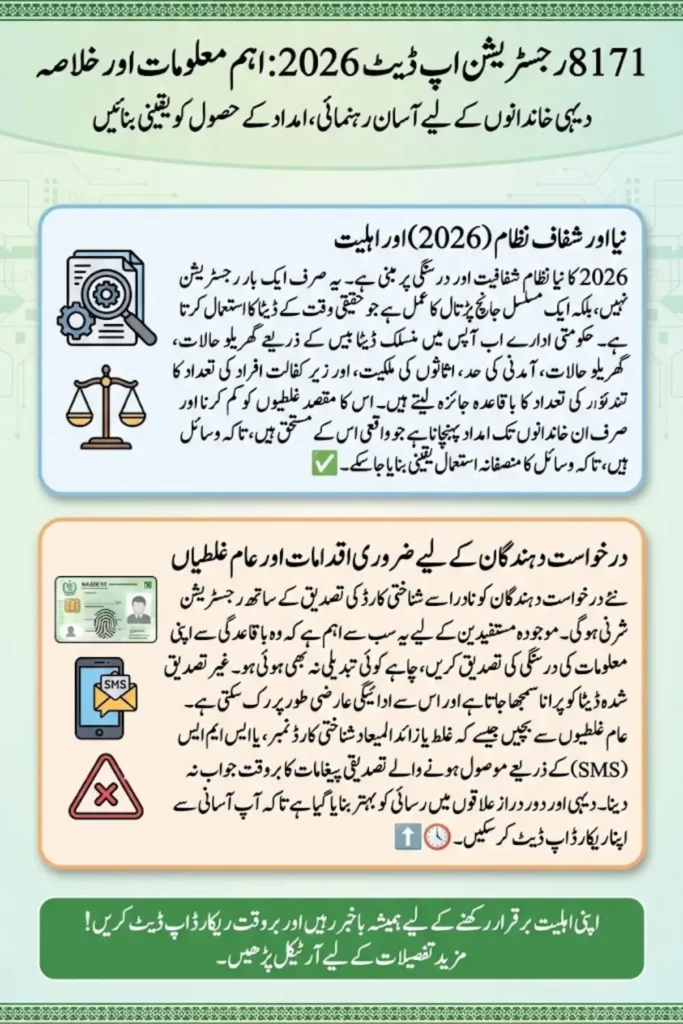
The core objective of the 8171 program remains the same: to identify and financially support low-income households across Pakistan. However, in 2026 the emphasis has shifted toward real-time data accuracy and continuous eligibility monitoring.

Government departments now rely on synchronized databases to assess household conditions more effectively. Instead of one-time registration, the system works as an ongoing evaluation mechanism. This change reduces misuse and ensures that assistance is distributed fairly among deserving families.
You Can Also Read: How to Secure an Asaan Karobar Scheme Loan: A Step-by-Step Eligibility Checker, Application Template & Real-Use Success Checklist

Eligibility Criteria for 8171 Registration in 2026
Eligibility screening in 2026 is more detailed than before. Applicants must meet defined income thresholds and asset conditions. The system also checks family structure, employment status, and dependency ratio.
Households with outdated records are more likely to face delays. Any change in marital status, number of dependents, or income source must be updated promptly. Even small inconsistencies can affect eligibility decisions, as the system now runs frequent background checks.
You Can Also Read: Up to Four Nominees for Bank Accounts Full Guide, Benefits and New Rules November 2026
8171 Registration Process for New Applicants
New applicants must begin with CNIC verification through official registration channels. This may include designated centers or approved digital platforms, depending on availability in the area.
After identity confirmation, household and financial information is collected. The system evaluates living conditions, income stability, and dependency factors before issuing an eligibility decision. Processing time may vary, but the structured approach ensures that assessments are unbiased and consistent.
Applicants should keep their registered mobile number active, as follow-up verification or clarification requests may be sent during the review period.
Data Update Requirements for Existing Beneficiaries
Receiving benefits in previous years does not guarantee continuation in 2026. Existing beneficiaries must regularly confirm that their information is accurate and current.
Even if no changes have occurred, verification prompts must be answered to avoid temporary suspension. The system treats unverified data as outdated, which can automatically pause payments until confirmation is completed.
This approach helps maintain program integrity and ensures that resources remain available for families still meeting eligibility standards.
You Can Also Read: BISP 8171 November 2026 Payments Check Your District Online
Key Differences Between 2025 and 2026 Registration System
| Feature | 2025 System | 2026 Updated System |
|---|---|---|
| Data verification | Periodic | Continuous |
| CNIC checks | Basic | NADRA-matched |
| Household updates | Optional | Mandatory |
| Eligibility review | One-time | Ongoing |
| Error tolerance | Higher | Stricter |
The updated structure minimizes false approvals and improves overall trust in the welfare distribution process.
Common Errors That Delay 8171 Approval
Many applicants face issues due to avoidable mistakes. Incorrect CNIC numbers, expired identity cards, or incomplete household data are among the most common causes of rejection or delay.
Ignoring system messages is another frequent problem. Verification requests must be answered within the given timeframe. Failure to respond can result in temporary disqualification, even if the applicant otherwise qualifies.
Careful data entry and timely responses significantly improve approval chances.
How Eligibility and Verification Are Checked
Once registration or data updates are submitted, the system cross-checks information with national databases. This includes identity validation, income assessment, and household composition review.
Verification results are communicated only through official channels. Processing time can increase during high-volume periods, but applicants are advised to remain patient and avoid relying on unofficial sources that often share inaccurate information.
You Can Also Read: BISP 8171 Program to Transfer 3rd Installment Directly Into Bank Accounts – Full Details Inside
Support Access for Remote and Underserved Areas
One of the most important improvements in 2026 is better access for applicants in remote regions. Mobile registration units and simplified procedures help reduce the need for repeated travel to urban centers.
This change allows families in rural and underserved locations to complete registration and verification with fewer obstacles, ensuring equal access to support regardless of location.
Final Guidance for 8171 Applicants in 2026
The 8171 Registration Update 2026 introduces a more disciplined, data-driven approach to welfare support in Pakistan. Accuracy, honesty, and responsiveness are now central to maintaining eligibility.
Applicants who stay informed, update their records promptly, and follow official procedures carefully are far more likely to receive timely assistance. The system rewards transparency and proactive participation, making it essential for families to treat registration as an ongoing responsibility rather than a one-time task.





With the right approach, the updated 8171 system can continue to serve as a reliable source of financial relief for deserving households across the country.
You Can Also Read: New Pakistani Passport Features – Mother’s Name Added, Security Upgrades & Exact Fee Guide