CM Maryam Nawaz Begins Punjab Mosque & Madrassa House-to-House Survey 2026-27 Across the Province

Punjab Mosque & Madrassa House-to-House Survey 2026-27
The Punjab government has officially launched the Punjab Mosque & Madrassa House-to-House Survey 2026-27 on the special instructions of Chief Minister Maryam Nawaz, which aims to prepare a complete, accurate and modern record of all religious institutions established across the province. In this survey, everything from the name of the mosque, school of thought, area, year of construction, capacity, information of the preacher and the number of daily and Friday prayers is being recorded regularly. This is the first time that the government is including the mosque and madrasa system in a modern database with complete transparency.
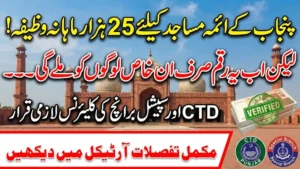
According to sources, this survey is going on very fast in Faisalabad, while teams are also going door to door in other districts to collect records of mosques. The most important thing is that the government is also working on a policy of providing a stipend of Rs 25,000 every month to all Imams through this survey, and for this, formal registration of Imams has been made mandatory. This is why field teams are going door to door to collect data from mosques so that no imam is left out and any wrong or suspicious activity can be brought to light. If you want to know how this survey will affect your mosque, how imams will get stipend, then read the entire article for complete details.

Why the Punjab Mosque & Madrassa Survey 2026 Was Launched
The Mosque & Madrassa Survey 2026 is a strategic initiative aimed at streamlining the religious infrastructure of the province. This large-scale survey seeks to:
- Build a centralized database of all mosques and madrassas
- Monitor unauthorized religious expansions
- Prevent misuse of religious spaces
- Detect illegal funding channels
- Strengthen district-level administrative control
- Counter extremist elements through informed oversight
This initiative ensures that each institution operates within the legal and administrative framework established by the provincial authorities.

How Field Teams Are Conducting the Province-Wide Survey
The government has deployed revenue department teams across all districts to conduct in-person visits. These teams are visiting households, mosques, and madrassas, collecting verified data and interviewing mosque administrators. The field staff has been strictly instructed to fill out the official Standard Mosque & Madrassa Proforma, ensuring that the collected information is accurate and uniform across all regions.
Faisalabad is the first district where the survey became fully operational, with staff working to complete it in a single day as per government directives.

Standardized Data Collection Form Introduced by Punjab Home Department
To maintain uniformity across the province, the Punjab Home Department has issued a Standardized Survey Form, which is mandatory for all district teams. This form includes more than a dozen crucial data fields, allowing the government to compile a comprehensive report on:
- Mosque identity and classification
- Administrative structure
- Leadership credentials
- Linked madrassa operations
- Religious capacity and infrastructure
This standardization helps the province develop a digital religious registry, which has never existed before at this scale.
Mandatory Mosque Information Required in the Survey
The survey mandates that every mosque must provide complete and verified information. The key data fields being collected include:
- Official name of the mosque
- Maslak (sect/school of thought)
- Year of construction
- Total covered area and plot size
- Maximum worshipper capacity
- Accurate geographical location
- Police station jurisdiction (Thana boundary)
- Daily prayer attendance statistics
- Friday congregation strength
- Availability of wudu areas and washrooms
- Residence facility for the khateeb
This detailed documentation helps authorities better understand each mosque’s structure and operational capacity.
Worshippers’ Attendance and Daily Prayer Records
A major portion of the Mosque Survey 2026 focuses on attendance tracking, including:
- Average attendance for Fajr, Zuhr, Asr, Maghrib, and Isha
- Number of Friday worshippers
- Special prayer events
- Seasonal worship patterns
These attendance metrics help authorities determine security requirements, infrastructure needs, and regional activity levels in religious institutions.
Documentation of Madrassas Attached to Mosques
The survey also requires detailed documentation for any madrassa affiliated with a mosque. Teams must record:
- Registration status of the madrassa
- Number of enrolled students
- Number of teachers and staff
- Curriculum details
- Organizational structure
- Residence facilities (if any)
This ensures that madrassas operate transparently and comply with provincial education regulations.
Complete Profiling of Khateebs and Religious Staff
One of the most critical aspects of the Punjab Mosque & Madrassa Survey 2026 is the profiling of mosque leadership. Survey teams collect comprehensive details about the khateeb, including:
- Full name and father’s name
- CNIC number
- Date of birth
- Academic qualifications
- Duration of employment
- Permanent and temporary addresses
- Contact phone numbers
This centralized khateeb database will help authorities monitor movement, employment, and the legitimacy of religious leadership across Punjab.
Administrative Committee Documentation
Every mosque must also provide verified details of its administrative committee, including:
- Name of President
- Name of General Secretary
- CNIC details
- Contact numbers
- Roles and responsibilities
This ensures accountability in mosque financial management, decision-making, and administrative control.
Faisalabad Survey Completion Deadline
Faisalabad has become the first district to implement the survey under strict orders. The Punjab government instructed all teams to ensure that the survey is completed in a single day (Friday), so that results can be forwarded to the central database immediately. Other districts are following the same model as the province rolls out the survey simultaneously across the region.
Purpose Explained by Additional Deputy Commissioner
Additional Deputy Commissioner (General) Fazal Abbas emphasized that the survey is not designed to interfere with religious activities but to:
- Stop illegal funding networks
- Detect radicalization activities
- Ensure administrative transparency
- Strengthen institutional accountability
- Protect public security and harmony
He clarified that the initiative will help authorities regulate religious institutions under a unified framework.
How the Survey Enhances Security and Governance
The Punjab Mosque & Madrassa Survey 2026 plays a crucial role in enhancing public safety and administrative governance. With a complete provincial database, authorities can:




- Monitor sensitive religious locations
- Prevent unregistered construction
- Identify illegal expansions
- Track foreign or unauthorized funding
- Ensure compliance with national guidelines
- Support law enforcement agencies with accurate intelligence
This system lays the foundation for improved religious management and reduced misuse of religious platforms.
Conclusion
The Punjab Government Mosque & Madrassa Survey 2026 represents a transformative step toward building a transparent, regulated, and well-documented religious infrastructure across the province. By introducing standardized documentation, profiling religious leadership, and monitoring linked madrassas, the government aims to strengthen administrative oversight and promote long-term stability. As field teams continue their district-wide operations, the initiative is expected to significantly enhance the province’s religious governance framework.